|
|||||||||||||||||||||||||||||||||||||||||||||||||||||||
| Past Issues | Subscribe | Advertise | myAST.org | |||||||||||||||||||||||||||||||||||||||||||||||||||||||

Important Dates
AST News
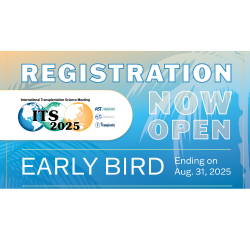
On behalf of the AST, the European Society for Organ Transplantation (ESOT), and The Transplantation Society (TTS), we are excited to announce that registration is officially open for the International Transplantation Science Meeting 2025.
ITS 2025 marks the fourth tri-society event in this global collaboration, bringing together top experts, early-career researchers, and transplant professionals worldwide. This meeting offers an exciting forum to explore cutting-edge basic and translational science in and beyond the field of transplantation.
Career Development Grants
The AST is now accepting applications for its 2026 Career Development Grant cycle! These grants promote the careers of early career investigators whose research relates to solid organ transplantation (and/or immunology relating to solid organ transplant).
Living Kidney Donor Medical Provider Toolkit
The Living Kidney Donor Medical Provider Toolkit has been fully updated! First published in 2018, the toolkit now includes revisions to all chapters and five new topics: genetic testing, international donor evaluation, GFR considerations, older donors, and tobacco/cannabis use.
ABIM Board Eligibility Pilot Program for "Exceptionally-Qualified" International Medical Graduates
The American Board of Internal Medicine (ABIM) has formally approved a pilot program offering a pathway to ABIM Board Eligibility in Internal Medicine for international medical graduates who complete an ACGME-accredited fellowship either as an ‘exceptionally qualified candidate’ or as a graduate of an internal medicine training program with ACGME-International advanced specialty accreditation.
Current Landscape of Kidney Transplant: IOTA Model and Reimbursement for Kidney Transplant Admissions
📅 Thursday, September 25
🕑 2:00 PM ET | 11:00 AM PT
The Centers for Medicare & Medicaid Services (CMS) has introduced the Increasing Organ Transplant Access (IOTA) model, a transformative initiative designed to help expand access to kidney transplants, enhance care coordination, and reduce Medicare expenditures.
Join us for this insightful and timely webinar where we’ll explore:
Transplant Community Survey on the Pre-Transplant Mortality Ratio Metric
This "Understanding the Impact of the Pre-Transplant Mortality Ratio Metric Implementation" survey focuses on how transplant professionals perceive and respond to the recently implemented pre-transplant mortality ratio metric by UNOS. The goal is to assess how the metric has influenced transplant center practices, particularly in patient listing and organ utilization.
OPTN Public Comment
Source: Organ Procurement & Transplantation Network
The OPTN summer public comment period began on August 27 and will run through October 1. You can find the proposals the OPTN released for comment this cycle on the OPTN website. Survey on Family Leave Practices for Transplant Professionals
This 10-minute survey is part of an ongoing AST Women’s Health Community of Practice (WHCOP) effort to better understand and improve support for transplant professionals when it comes to family leave and childrearing. The survey is expected to take less than 10 minutes to complete and will help with understanding the current practices and beliefs surrounding pregnancy and parental leave for transplant professionals. Responses will be used in research to identify gaps, inform best practices, and guide future policy and institutional recommendations to better support the transplant workforce.
Updates on Efforts and Resources Related to Transplant Nephrology Training
In fall 2024, the ACGME approved the application from the joint ASN-AST Task Force to recognize transplant nephrology as an accredited subspecialty of nephrology. By supporting a broad and nationwide adoption of uniformly rigorous transplant nephrology training, ASN and AST hope to improve the quality of care provided to patients in both the pre-and post-transplant phases.
A webpage has been created to share ongoing updates and resources related to this new accreditation.
New AJT Article: Transplant Recipients Share Perspectives on Immunosuppressant Needs
Source: American Journal of Transplantation
Last year, with your support, AST conducted a national patient survey that received nearly 10,000 responses from transplant recipients. The goal: to better understand perceptions of unmet immunosuppressant needs. The findings from this important research have now been published in the American Journal of Transplantation.
Share Your Perspective: Transplant Access and the Criminal Justice System
The AST Psychosocial and Ethics COP (PSECOP) is conducting a short survey to better understand transplant professionals’ perspectives on transplantation for patients who are incarcerated or involved in the criminal justice system. The results will help inform future policies and practices to improve care for this population.
The survey takes just 5–10 minutes to complete and is open to transplant professionals (coordinators, social workers, ILDAs, physicians, etc.) currently working at a U.S. transplant center. Please feel free to share the link with colleagues.
Questions? Contact the research team at emorytransplantresearch@emory.edu or reach out to Principal Investigator Megan Urbanski, PhD, MSW at megan.urbanski@emory.edu. This study has been approved by the Emory University Institutional Review Board.
AST Public Policy Form
The AST developed a survey aimed at soliciting your perspectives on legislative and regulatory issues that significantly influence both patient care and professional practice. Our goal is to establish a platform for our membership to share their invaluable ideas and perspectives and actively engage with the Public Policy Committee and AST leadership. We look forward to your input as we navigate the dynamics of our ever-evolving landscape of transplant care and practice.
Key Articles in Transplantation
A 12-Year Analysis of Equity and Efficiency in Living Kidney Donation at a Rural American Center
Source: Wiley Online Library
In the United States, a severe organ shortage precipitates an extensive transplant waitlist. Living donor kidneys are functionally superior to those from deceased donors and offer an alternative to close the supply-demand gap.
Mortality Outcomes of Combined Heart and Liver Transplantation and Isolated Heart Transplantation Following Fontan Procedures: A Systematic Review and Meta-Analysis
Source: Wiley Online Library
Fontan-associated liver disease can progress to advanced fibrosis, raising the potential need for combined heart–liver transplantation (CHLT) in selected patients. However, the benefits of CHLT over isolated orthotopic heart transplantation (HT), particularly in terms of mortality, remain uncertain. In this systematic review, we compared mortality outcomes following CHLT versus HT in patients with Fontan circulation, with the aim of supporting clinical decision-making.
International Society for Heart and Lung Transplantation (ISHLT) Consensus Statement on Risk Stratification in Pulmonary Arterial Hypertension
Source: The Journal of Heart and Lung Transplantation
The 7th World Symposium for Pulmonary Hypertension (PH) defined PH as a resting mean pulmonary arterial pressure (mPAP) of >20 mm Hg, as confirmed by right heart catheterization (RHC).1 PH is divided into 5 clinical subgroups; pulmonary arterial hypertension (PAH), PH associated with left-sided heart disease, PH associated with chronic lung disease and/or hypoxia, PH associated with pulmonary artery obstructions, and PH with unclear or multifactorial etiologies.1 Presently, an estimated 1% of the global population is affected by PH, including up to 10% of individuals older than 65 years 2. The higher incidence among those > 65 years is attributed to the increased presence of cardiac and pulmonary etiologies of PH.3–5 Regardless of etiology, PH is a complex pathophysiologic disorder that may involve multiple conditions and is frequently associated with deteriorating symptoms and increased mortality.
Diversity, equity, inclusion, and belonging in organ transplantation
Source: American Journal of Transplantation
Diversity, equity, inclusion, and belonging (DEIB) have implications for transplant access and outcomes. Inequities in transplantation have been identified over the years for minoritized groups based on race, ethnicity, sex, sexual orientation, gender identity, disability status, and other sociocultural identities. While DEIB initiatives have demonstrated success in improving transplant outcomes for some minoritized groups, many gaps still exist, and additional work is needed. Concerns about these practices have also been raised, and they may create barriers to achieving DEIB goals. This underscores the importance of transplant organizational commitment to practices that uphold the values of DEIB, as such efforts are effective in reducing transplant inequities and fostering an inclusive community. From this viewpoint, we reviewed the existing inequalities in transplant, importance of DEIB, common concerns about DEIB initiatives, and commitment of the American Society of Transplant to DEIB initiatives, including the foundation of Inclusion, Diversity, Equity, and Access to Life (IDEAL) committee. Recommendations for cultivating DEIB practices, as well as tips for managing backlash against DEIB initiatives, are also provided. All professionals within the field of transplantation should carefully consider these recommendations to help promote an inclusive community for patients, providers, and all key stakeholders.
|
|||||||||||||||||||||||||||||||||||||||||||||||||||||||
|

 Fellows Symposium on Transplantation Begins