|
||||||||||||||||||||||||||||||||||||||||||||||||||||||||
| Past Issues | Subscribe | Advertise | myAST.org | ||||||||||||||||||||||||||||||||||||||||||||||||||||||||

Important Dates
AST News
On behalf of the AST, the European Society for Organ Transplantation (ESOT), and The Transplantation Society (TTS), we are excited to announce that registration is officially open for the International Transplantation Science Meeting 2025.
ITS 2025 marks the fourth tri-society event in this global collaboration, bringing together top experts, early-career researchers, and transplant professionals worldwide. This meeting offers an exciting forum to explore cutting-edge basic and translational science in and beyond the field of transplantation.
Fellows Symposium on Transplantation
Know an early-career professional or student interested in transplantation? Encourage them to check out the AST Fellows Symposium! This unique program offers expert-led sessions and valuable networking with leaders in the field. It’s a great opportunity for fellows, residents, pharmacists, nurses, and students to explore career paths in transplant and build lasting connections.
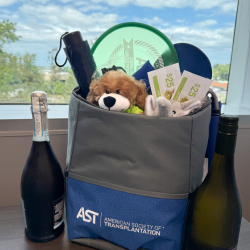
We're excited to offer a special giveaway in support of the Fellows Symposium on Transplantation! Each year, the AST empowers the next generation of transplant professionals through travel grants, making this essential educational experience accessible to emerging talent.
How to Enter
Now through September 18: Every $10 donation to Fund a Fellow = 1 entry to win our incredible prize package! Donate $100 and you’ll receive 12 entries (2 bonus entries!).
Prize Package Includes:
Your contribution directly funds travel opportunities for the transplant professionals who will lead our field tomorrow.
Transplant Community Survey on the Pre-Transplant Mortality Ratio Metric
This "Understanding the Impact of the Pre-Transplant Mortality Ratio Metric Implementation" survey focuses on how transplant professionals perceive and respond to the recently implemented pre-transplant mortality ratio metric by UNOS. The goal is to assess how the metric has influenced transplant center practices, particularly in patient listing and organ utilization.
OPTN Public Comment
Source: Organ Procurement & Transplantation Network
The OPTN summer public comment period began on August 27 and will run through October 1. You can find the proposals the OPTN released for comment this cycle on the OPTN website. Survey on Family Leave Practices for Transplant Professionals
This 10-minute survey is part of an ongoing AST Women’s Health Community of Practice (WHCOP) effort to better understand and improve support for transplant professionals when it comes to family leave and childrearing. The survey is expected to take less than 10 minutes to complete and will help with understanding the current practices and beliefs surrounding pregnancy and parental leave for transplant professionals. Responses will be used in research to identify gaps, inform best practices, and guide future policy and institutional recommendations to better support the transplant workforce.
 The AST is proud to recognize this year’s Fellows of the American Society of Transplantation (FAST). This honorary designation is awarded to members who have demonstrated exceptional commitment to the field of transplantation and outstanding service to the AST.
We celebrate the 2025 recipients for their dedication, leadership, and contributions that continue to advance our mission and strengthen the transplant community.
Updates on Efforts and Resources Related to Transplant Nephrology Training
In fall 2024, the ACGME approved the application from the joint ASN-AST Task Force to recognize transplant nephrology as an accredited subspecialty of nephrology. By supporting a broad and nationwide adoption of uniformly rigorous transplant nephrology training, ASN and AST hope to improve the quality of care provided to patients in both the pre-and post-transplant phases.
A webpage has been created to share ongoing updates and resources related to this new accreditation.
New AJT Article: Transplant Recipients Share Perspectives on Immunosuppressant Needs
Source: American Journal of Transplantation
Last year, with your support, AST conducted a national patient survey that received nearly 10,000 responses from transplant recipients. The goal: to better understand perceptions of unmet immunosuppressant needs. The findings from this important research have now been published in the American Journal of Transplantation. Share Your Perspective: Transplant Access and the Criminal Justice System
The AST Psychosocial and Ethics COP (PSECOP) is conducting a short survey to better understand transplant professionals’ perspectives on transplantation for patients who are incarcerated or involved in the criminal justice system. The results will help inform future policies and practices to improve care for this population.
The survey takes just 5–10 minutes to complete and is open to transplant professionals (coordinators, social workers, ILDAs, physicians, etc.) currently working at a U.S. transplant center. Please feel free to share the link with colleagues.
Questions? Contact the research team at emorytransplantresearch@emory.edu or reach out to Principal Investigator Megan Urbanski, PhD, MSW at megan.urbanski@emory.edu. This study has been approved by the Emory University Institutional Review Board.
AST Public Policy Form
The AST developed a survey aimed at soliciting your perspectives on legislative and regulatory issues that significantly influence both patient care and professional practice. Our goal is to establish a platform for our membership to share their invaluable ideas and perspectives and actively engage with the Public Policy Committee and AST leadership. We look forward to your input as we navigate the dynamics of our ever-evolving landscape of transplant care and practice.
Upcoming Education
Key Articles in Transplantation
PD-L1 on ex-vivo Expanded Toll-like-receptor-Bregs Prevents Allograft Rejection by Breg Viability Promotion, CD4+T Effector Cell Suppression, and Tregs Induction
Source: American Journal of Transplantation
Achieving immune tolerance is a key goal in organ transplantation, as it eliminates the need for long-term immunosuppression. Regulatory B cells (Bregs) present a promising strategy for inducing tolerance. Our previous findings demonstrate that the adoptive transfer of ex vivo-expanded murine splenic B regulatory cells, referred to as TLR-Bregs (TLR9/TLR4 stimulation), induces tolerance to allografts. Here, we identify that circulating T cells increase PD-1 expression following TLR-Bregs cellular therapy. To investigate whether PD-L1-PD-1 signaling is involved in tolerance induction by TLR-Bregs, we generate TLR-Bregs from wild-type (WT) or PD-L1-deficient (-/-, KO) B6 splenocytes and assess their regulatory functions. Our findings reveal that TLR-Bregs express high levels of PD-L1 and extend graft survival via a PD-L1-dependent mechanism. Mechanistically, PD-L1 enhances the activation and survival of TLR-Bregs; PD-L1 is required for TLR-Bregs to induce PD-1 expression and an optimal inhibition of effector CD4+T cells while promoting the formation of functional Foxp3hiCCR7hiCTLA4hiTregs. This study highlights the foundational role of PD-L1 in inducing tolerance by ex-vivo-expanded TLR-Bregs.
Partial Heart Transplant for Congenital Heart Disease
Source: JAMA Network
Among the 19 participants with irreparable congenital heart valve dysfunction, 53% were male and 47% female. The median age at the time of transplant was 97 days. The median follow-up was 26 weeks. Three patients received partial heart transplant of both semilunar valves, 7 underwent living pulmonary valve replacement in the pulmonary position, 2 had a living aortic valve allograft in the aortic position, and 7 had a living aortic valve allograft in the pulmonary position. Nine patients constituting the initial cohort of partial heart transplant recipients had their annular diameter and valve leaflet length longitudinally analyzed for growth.
First Report of Long-term Outcomes of 700 Pediatric Liver Transplants From India
Source: Journals LWW
Acceptance of pediatric liver transplantation (PLT) in this part of the world has been slow because of a number of considerations, including those of cost, infections, and the nonavailability of expertise. Despite several obstacles, PLT has seen impressive growth in the recent years. Against a backdrop of this changing landscape of PLT in India, we present our experience of performing 700 PLT over a period of 13 y.
|
||||||||||||||||||||||||||||||||||||||||||||||||||||||||
|

 Fellows Symposium on Transplantation Begins